Monday
Mar302020
Read more about:

 FNF Scotland on Monday, March 23, 2020 at 2:43PM
 Although this web site will remain online until we have finished transferring all material, please go to the new web site at https://www.sharedparenting.scot/ for current news and event listings. The newsletter generated by this web site will also be transferred to a new Shared Parenting Scotland newsletter very soon.
FNF Scotland on Monday, January 27, 2020 at 3:38PM  The new name for our charity is being launched at an event in Edinburgh on Monday 10th February from 6-9pm.
Key speakers are Sir James Munby and Amanda Masson. Sir James was the judge heading all the family courts in England and Wales until last year. He is now the chair of the Nuffield Family Justice Observatory. We will hear from him about his judicial experience of change and also how the Observatory is working to improve outcomes for children and supporting research and data collection.
The other main speaker is Amanda Masson, a partner at Harper Macleod LLP and Law Society of Scotland Accredited Specialist in Child Law, Family Law & Family Mediation. Amanda will talk about how the concepts of “contact” and “residence” could evolve in the Children (Scotland) Bill to embrace the notion of shared care. We will also present short filmed comments from a range of Scottish and international specialists on shared care, plus some quotes from parents and children who have made shared care work for them after separation.
To book a place at this event see
Launch event FNF Scotland on Friday, January 24, 2020 at 3:38PM  Photo by Feliphe Schiarolli on UnsplashA Scottish council has backed down in its refusal to engage with a father who wanted information about his child's progress at school and to be included in events and information flow that would allow him to support his child's learning.
The council had told the father repeatedly over several months that because he did not have formal Parental Rights and Responsibilities (PRR) they would not engage with him.
They accepted that there was no issue about safety or the sincerity of his wish to support his child but told him that "it is our policy in all such cases" to refuse to recognise the the rights of a parent who does not have Parental Rights and Responsibilities. In this case the father is not named on the birth certificate.
The father drew the council's attention repeatedly to the definition of 'parent' in terms of the 1980 Education (Scotland) Act that does not require PRR but the response was that the council saw "nothing in the 1980 Act" to change its refusal.
Representing the father on a pro bono basis, solicitor, Fiona Rasmussen of Gibson Kerr in Edinburgh wrote to the council legal department on Monday January 20th advising that it was her client's intention to take the council's policy to judicial review. Within 24 hours the council legal department abandoned its previous position and stated it now accepts that the father has full rights to engagement with his son's learning and involvement in the life of the school community.
Ian Maxwell, national manager of Shared Parenting Scotland (formerly Families Need Fathers Scotland) says. "The council was politely told by the father over and over again that its policy was unlawful but refused to budge. They were quite insulting to him. We are very grateful for the pro bono assistance of Gibson Kerr to progress the case to the point of judicial review.
We have chosen not to name the council in the case because we are aware that there are a handful more across Scotland that still think they are entitled to impose their own opinions over and above the law. It is more important to work together rather than score points. However, I will be writing to the council in this case asking it to make it clear that their entire 'policy in all such cases' has gone and not just their decision with respect to this father. Being involved with your child's learning at school is an important part of meaningful parenting."
Fiona Rasmussen of Gibson Kerr says, "'I was pleased to be able to help out in this case. In my view, the school's initial decision was plainly wrong from a legal standpoint and it was likely to have long lasting implications for this child and the father. It was great to see that the council reversed its decision so quickly when challenged. This will mean that the father will now be able to participate fully in his child's education in the future.'
Janys Scott QC, editor of Education Law in Scotland (published by W Green), says, "The Education (Scotland) Act 1980 defines who is a “parent” for the purposes of all rights and responsibilities under that Act and related legislation The definition is found in section 135(1). It reads:
... "parent” includes guardian and any person who is liable to maintain or has parental responsibilities (within the meaning of section 1(3) of the Children (Scotland) Act 1995) in relation to, or has care of a child or young person;”
Even without Parental Responsibilities and Parental rights under the Children (Scotland) Act 1995, a father qualifies as a “parent” because he is a person who is liable to maintain his child.
That means all fathers are under a duty to provide their children with an education and can be prosecuted if they do not. On the other hand if their children attend state schools fathers are entitled to receive school reports and information about their child. The law requires state schools to involve them in their child’s education and the life of their child’s school."
FNF Scotland on Tuesday, January 14, 2020 at 3:11PM 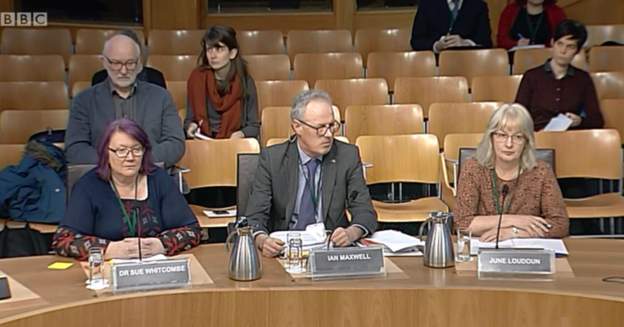
Chartered psychologist Dr Sue Whitcombe, Ian Maxwell from Shared Parenting Scotland and June Loudoun from Grandparents Apart UK gave evidence on Tuesday 14th January to the Scottish Parliament Justice as part of their Stage 1 consideration of the Children (Scotland) Bill. The session can be viewed on Parliament TV and was also covered on the BBC.
A transcript of the session is now avalable at this link.
Committee questions ranged across the various aspects of the Bill including children's participation in decisions about them, parental alienation, how should children's views be obtained, parental rights and enforcement of contact orders.
In his evidence, Ian Maxwell stressed that by no means all Section 11 cases are about domestic abuse. The Bill documentation mentions the estimate that 50% involve allegations of abuse. As the Faculty of Advocates states in their submission, “This can range from serious assault and coercive control to those in which have little or no foundation but cause prejudice to an opponent.” He stated that many of the people who are in these court hearings are worthy parents and their children deserve to see them, not be protected from them.
Responding to a question from Fulton Macgregor MSP, he stated that the mention of Contact and Residence orders in the law is inaccurate and misleading. Parents who get a residence order mistakenly think that puts them in charge. Such terms have been removed in many other countries, in England in 2014 and in Canada in 2019.
He explained that we are supporting a rebuttable presumption of shared care because it provides a clear starting point for the sheriff in considering arrangements for a child. At present the starting point is usually set very low – anything from a weekly hour in a contact centre to every 2nd weekend. Judges in Belgium say that their law change gave them a much clearer starting point. This does lead to more shared care decisions, but currently only in about 50% of court cases.
By no means all Section 11 cases are about domestic abuse. The Bill documentation mentions the estimate that 50% involve allegations of abuse. As the Faculty of Advocates states in their submission, “This can range from serious assault and coercive control to those in which have little or no foundation but cause prejudice to an opponent.” Many of the people who are in these court hearings are worthy parents and their children deserve to see them, not be protected from them.
Children (Scotland) Bill, family law